Dragon Professional alternative for desktop dictation
Compare against Dragon Professional v16 for general Windows documentation. OpenTypeless does not reproduce every professional command, deployment control, or medical workflow. Retain a validated specialized workflow when those features are required.
OpenTypeless product UI
Before comparing feature lists, see the product UI states users touch when switching from Dragon Professional.
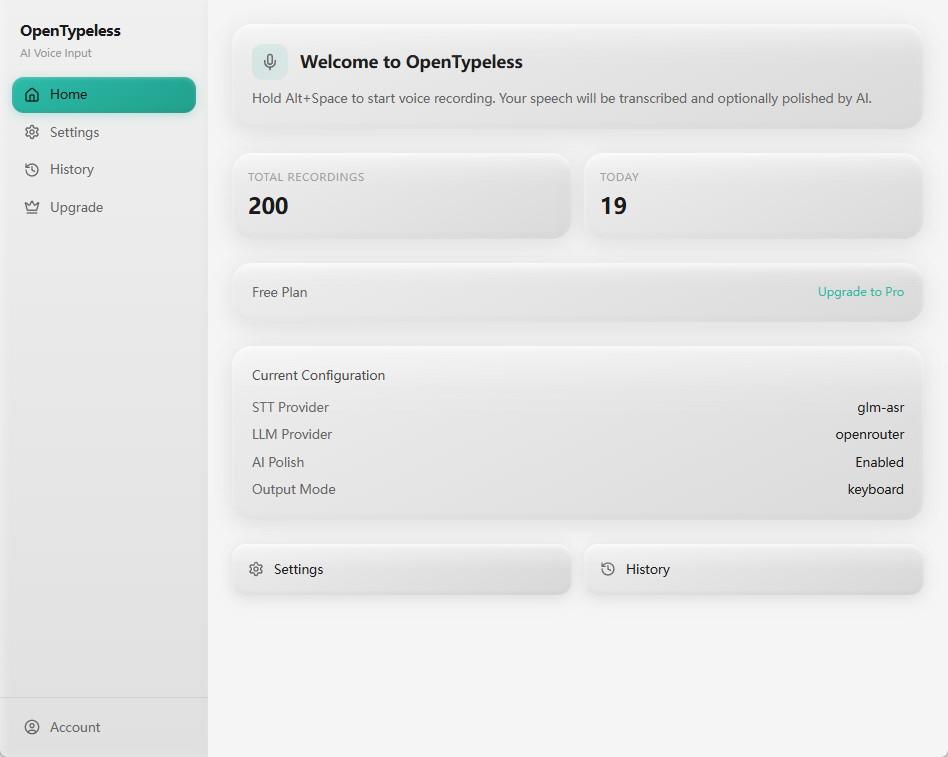
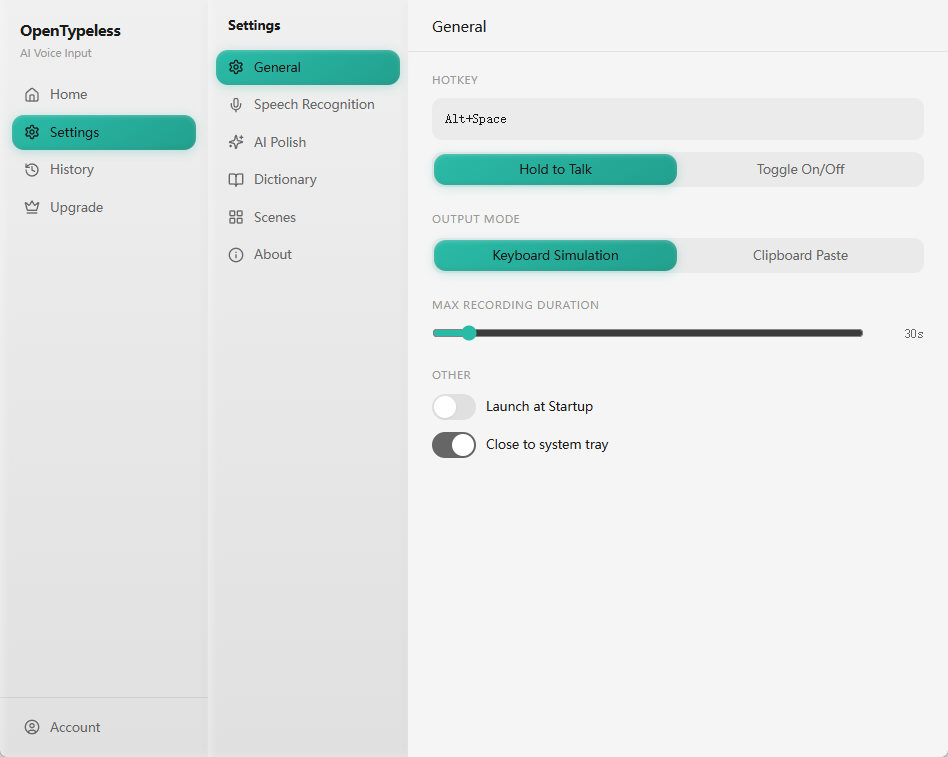
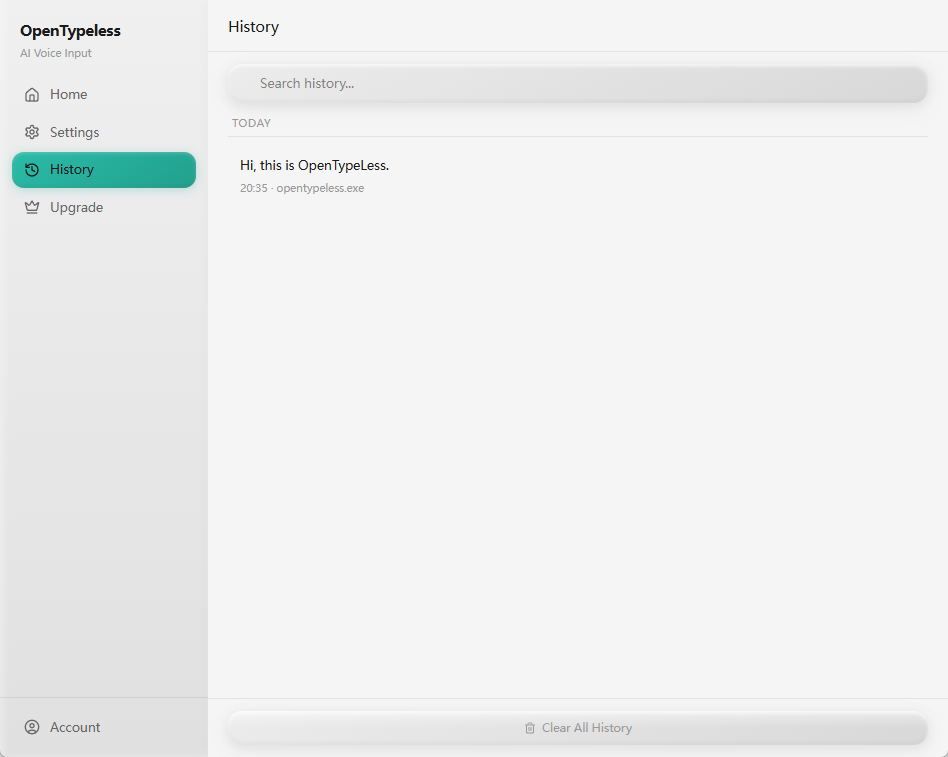
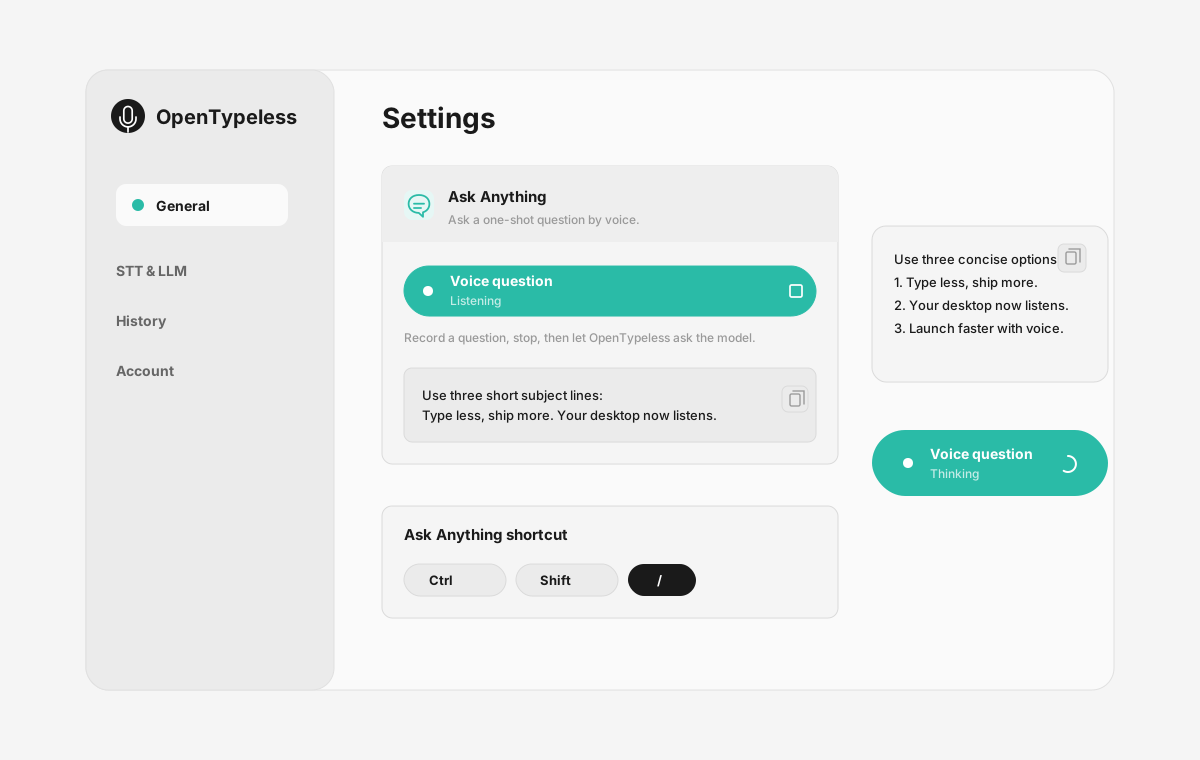
| Stage | Evidence | Why it matters |
|---|---|---|
| Desktop capture | A visible recording surface instead of a generic feature claim. | Users comparing Dragon Professional can see where OpenTypeless fits into daily typing. |
| Provider control | Settings expose STT and LLM choices in one place. | The page shows the concrete control behind BYOK, local, and cloud workflows. |
| Output review | History gives users a place to check previous voice input results. | This makes the workflow feel inspectable instead of a one-shot black box. |
| Ask Anything | A small floating answer note handles voice questions without opening a chat app. | Users can compare not only dictation, but the second workflow: ask by voice and read the result. |
Plan your switch from Dragon Professional
Configure the replacement workflow before retiring the shortcuts and vocabulary you use today.
- List the apps, editable fields, language, and dictionary terms that your current workflow must preserve.
- Install the appropriate OpenTypeless desktop build and configure an STT route. Configure optional LLM polishing separately.
- Set a shortcut that does not conflict with the previous app, and add your important terminology to the dictionary.
- Dictate a representative passage, review insertion and corrections, and verify the selected routes before switching daily work.
Official documentation checked 2026-10-08. Edition and configuration limits are stated per row. No controlled speed or accuracy winner is claimed.
Feature Comparison
OpenTypeless vs Dragon Professional
| Feature | OpenTypeless | Dragon Professional |
|---|---|---|
| Price and plan | MIT desktop app; provider and managed-service costs are separate | Commercial Dragon Professional licensing; medical and other editions have separate termsSource |
| Platform | Windows / macOS / Linux | Dragon Professional v16 for Windows 11 and Windows 10Source |
| Source and license | MIT License | Commercial application; the cited overview does not offer a source-code licenseSource |
| Speech recognition | 7 named BYOK STT providers | Live speech-to-text and transcription of existing audio filesSource |
| Text processing | 11 providers (BYOK) | Professional documentation workflow; arbitrary LLM provider selection is not described hereSource |
| Languages | 99 languages | Language coverage depends on the purchased edition; this page is not a language benchmarkSource |
| Custom vocabulary | Yes | Professional dictation and administration features; exact vocabulary behavior is edition-specificSource |
| Data and processing route | A Custom Whisper-compatible endpoint is the local or self-hosted STT path; whether audio leaves the machine depends on the configured endpoint and network. Ollama is a local LLM provider for text polishing and other LLM work. | This overview does not establish the processing and retention path of every Dragon editionSource |
| Primary workflow | Desktop dictation, optional transcript polishing, insertion, and one-off voice questions | Document-intensive professional work; Dragon Medical and Dragon Anywhere are separate productsSource |
Choose by workflow
Compare against Dragon Professional v16 for general Windows documentation. OpenTypeless does not reproduce every professional command, deployment control, or medical workflow. Retain a validated specialized workflow when those features are required.
Speech recognition route
Live speech-to-text and transcription of existing audio files
Text processing
Professional documentation workflow; arbitrary LLM provider selection is not described here
Source and license
Commercial application; the cited overview does not offer a source-code license
Platform fit
Dragon Professional v16 for Windows 11 and Windows 10
Switching from Dragon Professional
Quick Migration
Compare against Dragon Professional v16 for general Windows documentation. OpenTypeless does not reproduce every professional command, deployment control, or medical workflow. Retain a validated specialized workflow when those features are required.
When Dragon Professional fits
We respect the competition
Document-intensive professional work; Dragon Medical and Dragon Anywhere are separate products
Live speech-to-text and transcription of existing audio files
Compare against Dragon Professional v16 for general Windows documentation. OpenTypeless does not reproduce every professional command, deployment control, or medical workflow. Retain a validated specialized workflow when those features are required.
Frequently Asked Questions
Is OpenTypeless as accurate as Dragon?
Run the same representative recordings through both workflows and compare recognition errors, formatting, and terminology. Results depend on the selected STT model, audio, dictionary, and Dragon edition.
Does it work across desktop writing apps like Dragon?
OpenTypeless uses a global system hotkey across its documented supported desktop baseline. It is built for dictation, AI polishing, and bounded writing actions in text fields, not for general desktop-control commands.
Can I use desktop-control commands like in Dragon?
OpenTypeless is focused on voice input, AI text polishing, and bounded writing actions. It is not a general desktop-control command system and does not execute arbitrary app-control commands.
Do I lose my Dragon vocabulary when switching?
Review the current export options for your Dragon edition, then add the important medical, legal, or technical terms to the OpenTypeless custom dictionary and verify them with representative recordings.
What costs should I expect?
The desktop app is MIT-licensed. Review the current billing terms for the STT and optional LLM routes you configure, including usage rules, minimums, regions, and managed-plan charges.
Ready to Try OpenTypeless?
Free, open-source, and works on Windows, macOS, and Linux. Set up in under 5 minutes.