Best Typeless Alternatives for Voice Dictation
Typeless now covers managed voice typing on desktop and mobile, so a useful alternative list must compare more than transcription quality: setup ownership, operating systems, provider control, local routes, and where finished text goes.
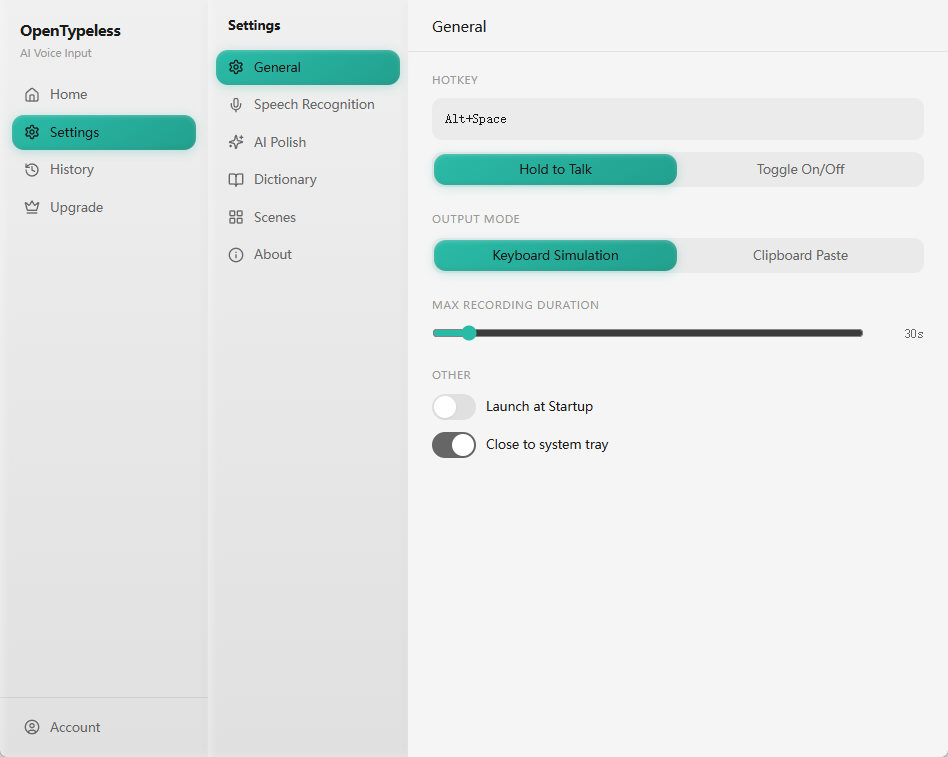
OpenTypeless is a relevant option for users who want open-source code, Linux support, and a choice between managed Cloud, BYOK providers, or a self-hosted Whisper-compatible endpoint. Review each managed product’s current device documentation, and test local-model candidates with the same representative tasks; built-in dictation can remain sufficient for short, occasional input.
GSC and competitor research was reviewed on 2026-06-30; product platforms, setup paths, and first-party sources were rechecked on 2026-07-21. No controlled accuracy or latency winner is claimed.
How to decide
Choose based on the job, not only the keyword.
Choose the ownership model first
Typeless is a managed service. OpenTypeless lets you use managed Cloud, your own provider keys, or an endpoint you operate. That difference affects setup, privacy review, support, and ongoing cost.
Separate desktop from mobile
Review Typeless’s current product documentation for device availability before deciding. Treat mobile keyboard support as a separate requirement before testing any desktop alternative.
Do not trust an untested accuracy winner
No controlled, same-microphone benchmark was completed for this update. Test the same accent, vocabulary, microphone, application, and cleanup task before treating any product as the accuracy leader.
Best-fit options
Use these cards as starting points, then read the linked comparison or setup page for more detail.
OpenTypeless
Best when you want Windows, macOS, and Linux support, BYOK provider control, AI text polishing, custom vocabulary, and Ask Anything voice Q&A.
Wispr Flow
A strong commercial option for users who prefer a managed product and do not need OpenTypeless-style open-source control.
SuperWhisper
A strong fit for many macOS users. OpenTypeless is stronger when cross-platform support and open-source control matter.
Built-in dictation
Good for quick phrases. It is less suited to provider choice, AI polishing, custom dictionaries, and repeatable desktop workflows.
Product-specific details
Choose the workflow that fits your applications, then follow the setup and review steps below.
How this shortlist was reviewed
The review used first-party download, setup, pricing, privacy, and product documentation available on July 21, 2026, plus the current OpenTypeless application and repository. Products were grouped by the job they fit instead of receiving invented star ratings or a universal score.
The criteria are platform coverage, account and API-key requirements, source availability, managed versus user-controlled providers, local or self-hosted paths, AI cleanup, text insertion, and mobile availability. Pricing is deliberately described by plan shape because vendors can change currencies, quotas, and promotions after this page is published.
When staying with Typeless is the sensible choice
Typeless can remain relevant when you want a managed voice keyboard, prefer not to choose STT or LLM providers, and value its in-place voice actions. Review its current download and product documentation for device availability before deciding.
A switch is not automatically an upgrade. If mobile is essential, the managed workflow already meets your privacy requirements, and the current plan fits your usage, moving to a desktop-only open-source product may add configuration without solving a real problem.
Where OpenTypeless is meaningfully different
OpenTypeless is most relevant when source access, Linux, provider choice, or deployment control is the reason for searching. The simplest route is managed Cloud when the account has cloud entitlement; it does not require a separate speech-provider key. BYOK routes require credentials from the selected STT provider and, when AI polishing is enabled, the selected LLM provider.
A Custom Whisper-compatible endpoint is the local or self-hosted STT path; whether audio leaves the machine depends on the configured endpoint and network. Ollama is a local LLM provider for text polishing and other LLM work.
Why the single-product and roundup pages are separate
Use this page when you are still building a shortlist. It compares several product classes and helps narrow the field by scenario. Use the OpenTypeless versus Typeless page when the decision is specifically whether to stay with Typeless or move one existing workflow.
Keeping those intents separate also makes the evidence clearer: this roundup can explain which products belong in the test, while the focused switching page can document setup choices, migration risks, and the exact tradeoffs between two products.
Typeless alternatives by scenario
Start with the constraint that would actually make you switch.
| Decision point | Option | What to know |
|---|---|---|
| Open source, Linux, or BYOK | OpenTypeless | Relevant when source access, Linux desktop support, configurable providers, and a self-hosted endpoint option are the deciding factors. |
| OpenWhispr | Another cross-platform open-source candidate with local and cloud model paths; compare its exact modes and insertion workflow. | |
| Managed cross-device experience | Typeless | Stay when its desktop and mobile voice keyboard, managed setup, and in-place actions already fit. |
| Wispr Flow | Test as another managed option after reviewing its current device documentation and system requirements. | |
| Mac and local-model priority | SuperWhisper | A candidate with documented Mac, Windows, iOS, and Android support, local Whisper in Free, and additional cloud and AI functions in Pro. |
| VoiceInk | A Mac-focused open-source option for users comfortable evaluating local models and build or signed-app expectations. | |
| Occasional, no-install dictation | Built-in dictation | Often enough for short phrases when provider control, history, and AI restructuring are unnecessary. |
| Dedicated app | Worth the added setup when long-form cleanup, vocabulary, consistent shortcuts, or cross-app history saves repeated work. |
Run a fair Typeless alternative test
Use the same inputs and record the remaining edits instead of comparing polished marketing demos.
Pick four representative tasks
Use a short message, a rambling email, a technical paragraph with names, and one in-place rewrite or voice question.
Hold the environment constant
Use the same microphone, room, operating system, application, language, and source text for every candidate.
Record setup and cleanup effort
Note account creation, permissions, provider keys, model setup, failures, and how many manual edits remain in the final text.
Check the real data path
Confirm whether audio uses a managed cloud, your provider account, or a self-hosted endpoint, and verify the current plan or quota before heavier use.
FAQ
Short answers for users comparing tools and workflows.
How should I choose a lower-cost Typeless alternative?
OpenTypeless is a strong open-source desktop option, and built-in operating-system dictation is the simplest no-install option. “Free” does not automatically include hosted STT or LLM usage, so check Cloud entitlement or your BYOK provider costs.
Is OpenTypeless a Typeless clone?
No. Both address voice input, but OpenTypeless emphasizes source access, cross-platform desktop support including Linux, configurable STT and LLM routes, and an explicit Cloud/BYOK/self-hosted setup choice.
Does OpenTypeless download a local Whisper model?
A Custom Whisper-compatible endpoint is the local or self-hosted STT path; whether audio leaves the machine depends on the configured endpoint and network. Ollama is a local LLM provider for text polishing and other LLM work.
Do I need an API key to use OpenTypeless?
Not for the managed Cloud route when your account has cloud entitlement. BYOK requires the chosen provider credentials. A self-hosted Whisper-compatible endpoint may not require a key, depending on how you configured that server.
Is Typeless only available on Mac?
No. Review Typeless’s current device documentation before deciding; an undated Mac-only comparison should not be treated as current evidence.
Which option is most accurate?
This review does not name an accuracy winner because no controlled same-audio benchmark was completed. Accuracy changes with microphone, language, accent, vocabulary, model route, and the amount of AI rewriting applied after transcription.
Related pages
Continue through the strongest internal-link path.
Download OpenTypeless
Try the desktop app on a low-risk writing task.
OpenTypeless vs Typeless
Read the focused switching and setup comparison.
Wispr Flow alternatives roundup
Compare the managed-product side of the category.
SuperWhisper alternatives roundup
Explore configurable and local-model-oriented candidates.
AI dictation apps roundup
Compare the broader AI voice typing category by workflow.
Try the desktop voice input workflow
Start with the default setup, then tune providers, shortcuts, local mode, and Ask Anything as your workflow becomes clearer.
Resources
- A Practical Typeless Alternative: OpenTypeless
- OpenTypeless vs Typeless: Setup, Platforms, and Control
- Typeless Download Alternative
- Typeless Download Guide: Get OpenTypeless Safely on Desktop
- Typeless for Windows Alternative
- OpenTypeless for Windows: Setup, Hotkeys, and Text Insertion
- Typeless for Mac Alternative
- Typeless GitHub and Open Source Alternative
- OpenTypeless on GitHub: What to Check Before You Build or Contribute
- Typeless vs Wispr Flow vs OpenTypeless
- Typeless vs SuperWhisper vs OpenTypeless
- Typeless on Linux: Set Up OpenTypeless for Ubuntu, Fedora, and Arch