OpenTypeless vs Wispr Flow: Setup, Platforms, and Control
This comparison separates setup, platform coverage, provider ownership, privacy controls, and daily workflow so you can decide between OpenTypeless and Wispr Flow without relying on stale feature tables or unsupported accuracy claims.
Choose Wispr Flow for a managed product experience with its documented desktop and mobile coverage. Choose OpenTypeless when open-source code, Linux, and control over Cloud, BYOK, or a user-run Whisper-compatible endpoint outweigh mobile availability and zero-config provider setup. Accuracy remains a test question, not a marketing conclusion.
GSC and competitor research was reviewed on 2026-06-30; first-party platform and plan descriptions were checked on 2026-10-08. OpenTypeless capabilities remain scoped to the documented desktop baseline. No controlled accuracy or latency winner is claimed.
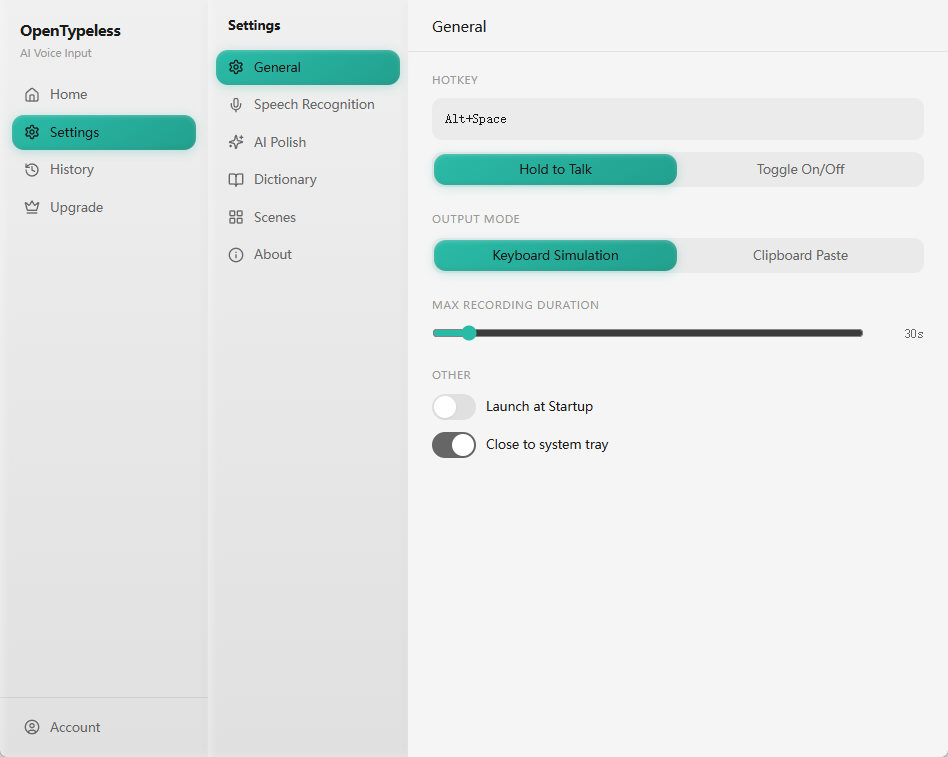
How to decide
Choose based on the job, not only the keyword.
Managed service or configurable stack
Wispr Flow asks the user to install, sign in, and grant operating-system permissions. Its normal setup does not require a separate speech-provider API key. OpenTypeless exposes more choices, which provides control but also makes the user responsible for selecting and testing the route.
Desktop and mobile are different requirements
Wispr Flow currently lists Mac, Windows, iPhone, and Android.
Benchmarks need a repeatable method
No same-microphone, same-audio accuracy and latency benchmark was completed for this update. Product fit can be compared now; a performance winner should wait for controlled evidence.
Product-specific details
Choose the workflow that fits your applications, then follow the setup and review steps below.
Wispr Flow as it exists now
Wispr Flow fits users who want a polished managed service, product-run transcription, cross-device availability, team options, and fewer provider decisions during setup.
Wispr Flow currently lists Mac, Windows, iPhone, and Android. Wispr Flow currently lists a Free tier and paid Pro, Growth, and Enterprise plans; dictation and meeting-note entitlements differ by plan. Older pages that describe the product as Mac-only or attach a fixed price without a review date should not be used for a current purchase decision.
How OpenTypeless actually works
OpenTypeless has three practical setup paths. Managed Cloud is the simplest when the account has cloud entitlement and does not require a separate provider key. BYOK sends requests through providers selected and funded by the user, so the chosen STT key is required and an LLM key is also needed when that provider handles AI polishing.
A Custom Whisper-compatible endpoint is the local or self-hosted STT path; whether audio leaves the machine depends on the configured endpoint and network. Ollama is a local LLM provider for text polishing and other LLM work.
Privacy depends on the selected data path
Wispr states that transcription runs in the cloud. Its Privacy Mode and Private Cloud Sync controls separately govern model improvement and server-side storage behavior. That product-specific behavior should be reviewed in the official source links below rather than reduced to a generic “private” or “cloud only” badge.
OpenTypeless cannot have one universal data-path claim because Cloud, BYOK, and self-hosted configurations send data to different destinations. Review the selected STT and LLM providers, server logs, retention settings, and network path before using sensitive dictation.
A fair head-to-head method
Run both products with the same microphone, room, language, target application, and four input samples: a short message, a rambling email, a technical paragraph, and an in-place rewrite or question.
Measure the final result rather than raw transcript theater: remaining factual errors, unwanted rewriting, manual edits, insertion failures, time to usable text, and whether the product’s account or provider model fits continued use.
Sources and review notes
Current product details were checked against first-party pages. Pricing, platform support, and feature availability can still change.
Wispr Flow plans
First-party plan, quota, and localized pricing details.
Wispr Flow supported devices
First-party platform and system-requirement details.
Wispr Flow privacy
First-party cloud processing, privacy, and retention controls.
OpenTypeless source repository
Current product documentation for desktop platforms, Cloud/BYOK setup, and custom Whisper-compatible endpoint behavior.
Wispr Flow and OpenTypeless by decision point
The products overlap on voice input, but their setup and ownership models are materially different.
| Decision point | Option | What to know |
|---|---|---|
| Best-fit user | Wispr Flow | Wispr Flow fits users who want a polished managed service, product-run transcription, cross-device availability, team options, and fewer provider decisions during setup. |
| OpenTypeless | Best for desktop users who prioritize source access, Linux, configurable providers, and control over managed, BYOK, or self-hosted routes. | |
| Platform coverage | Wispr Flow | Wispr Flow currently lists Mac, Windows, iPhone, and Android. |
| OpenTypeless | Windows, macOS, and Linux desktop; no current mobile keyboard. | |
| Initial setup | Wispr Flow | Wispr Flow asks the user to install, sign in, and grant operating-system permissions. Its normal setup does not require a separate speech-provider API key. |
| OpenTypeless | Managed Cloud can avoid provider keys; BYOK requires provider credentials; self-hosted STT requires a compatible server that the user operates. | |
| Privacy review | Wispr Flow | Wispr states that transcription runs in the cloud. Its Privacy Mode and Private Cloud Sync controls separately govern model improvement and server-side storage behavior. |
| OpenTypeless | Review Cloud, BYOK, and self-hosted paths separately because each route has different processors, retention controls, and operational responsibility. | |
| Pricing and usage | Wispr Flow | Wispr Flow currently lists a Free tier and paid Pro, Growth, and Enterprise plans; dictation and meeting-note entitlements differ by plan. |
| OpenTypeless | The desktop source is available under MIT; managed Cloud follows account entitlement, BYOK follows provider billing, and self-hosting carries infrastructure cost. |
Test OpenTypeless and Wispr Flow side by side
A representative workflow test with four tasks reveals more than an undated feature checklist or a vendor-provided speed claim.
Name the decision constraint
Write down whether the real issue is Linux, mobile, source access, provider control, pricing, privacy, vocabulary, or output quality.
Configure the intended route
For OpenTypeless, choose managed Cloud, BYOK, or a self-hosted endpoint deliberately; do not compare one route while planning to use another.
Repeat four real tasks
Use the same message, email, technical paragraph, and AI action with the same microphone and target apps.
Review the complete cost of ownership
Include plan limits, provider accounts, local server maintenance, mobile needs, setup time, support expectations, and remaining manual edits.
FAQ
Short answers for users comparing tools and workflows.
Is OpenTypeless a good Wispr Flow alternative?
Yes when the switching reason is Linux, source access, provider choice, BYOK, or a self-hosted route. It is less suitable as a replacement when a mobile keyboard and fully managed provider setup are essential.
Does OpenTypeless require an API key?
Managed Cloud does not require a separate provider key when the account has cloud entitlement. BYOK requires credentials for the selected providers. A self-hosted endpoint may omit authentication if the user configured it that way.
Does OpenTypeless install a local Whisper model?
No. The user runs a compatible speech server and connects OpenTypeless to its base URL and model. Ollama can provide local LLM polishing but does not perform the speech-to-text step.
Which is more accurate, OpenTypeless or Wispr Flow?
This page does not declare a winner. A credible result requires controlled audio, the same microphone and environment, documented model routes, multiple languages or accents, and measurement of both transcription errors and unwanted rewriting.
Should I leave Wispr Flow immediately?
No. Keep the current workflow available and test OpenTypeless on low-risk text first. Switch only if it solves a named problem and still meets your platform, privacy, support, and mobile requirements.
How should I compare current prices?
Use the official product pages on the day you decide. For OpenTypeless, separate desktop source access from managed Cloud entitlement, third-party BYOK billing, and any self-hosting cost.
Related pages
Continue through the strongest internal-link path.
Download OpenTypeless
Start with a low-risk desktop dictation task.
Wispr Flow switching guide
Open the migration-focused version of this decision.
Best Wispr Flow alternatives
Build a multi-product shortlist before choosing.
BYOK voice dictation
Understand provider credentials, billing, and routing.
OpenTypeless pricing and Cloud
Review current entitlement and hosted usage terms.
Try the desktop voice input workflow
Start with the default setup, then tune providers, shortcuts, local mode, and Ask Anything as your workflow becomes clearer.