Context-aware writing
Context-aware writing
Free, open-source AI voice input for desktop. Speak naturally in any app, then optionally let AI polish text for email, chat, documents, and technical work.
Spoken input
The launch was Friday, actually Monday. Monday is final. Ask Sam to confirm.


Product flow
From voice to app-shaped writing
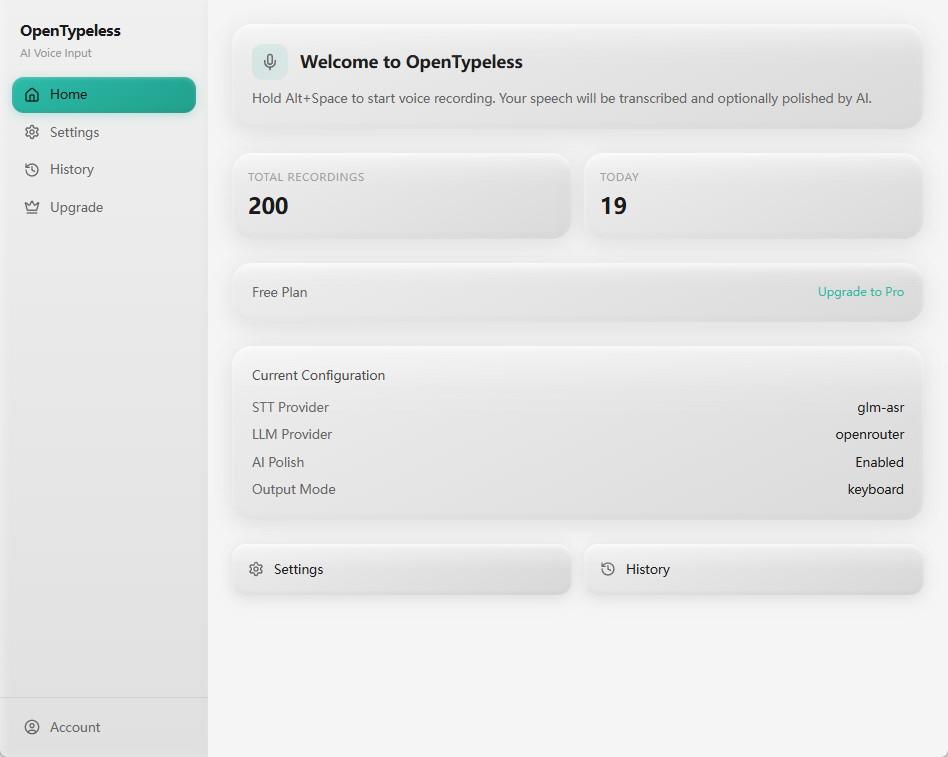
OpenTypeless keeps the workflow simple: speak once, let the local app profile shape the draft when AI polishing is enabled, then review the text before using it.
Context stays bounded
The page shows writing behavior, not hidden access. App names identify the surface; OpenTypeless does not claim account access or read private app history.
What it does
OpenTypeless classifies the active writing surface local, chooses one of 71 profiles, and uses AI polishing only when enabled.
One thought, four styles
Facts stay the same; tone, length, structure, and terminology change for the writing surface.
Spoken input
The launch was Friday, actually Monday. Monday is final. Ask Sam to confirm.
Local classification, reviewed policy
The app family is classified local and mapped to one of 71 built-in profiles. Unknown apps use General.
What context can change
Context changes presentation, not facts.
What context never changes
OpenTypeless does not invent missing business facts.
Voice intent and output placement
Output stays where you work
OpenTypeless types into the active writing surface.
Privacy boundaries
Raw app signals are not sent as context.
| Signal | Where it stays | Used for | Sent as context |
|---|---|---|---|
| Semantic app family | Local device | Choose writing profile | Only the semantic profile label may guide polishing |
| Raw process, window title, browser host, URL path, query, fragment, and page content | Local classification boundary | Detect app family | No |
| Dictated or selected text | Your chosen STT/LLM path | Transcription, rewriting, translation, asking, or search intent | Only as needed for the action you request |
Supported categories
The 71 profiles cover everyday writing surfaces.
Limits to understand
Context awareness is useful but bounded.
FAQ
Does OpenTypeless read my screen?
No. It does not read full page, document, or conversation contents to build context.
Are app names integrations?
No. App names and logos are nominative compatibility identifiers, not endorsement, partnership, certification, or integration claims.
What happens for an unknown app?
Unknown or ambiguous apps use General.
Try context-aware voice typing
Download OpenTypeless, review the 71 app profiles, or read context privacy documentation.